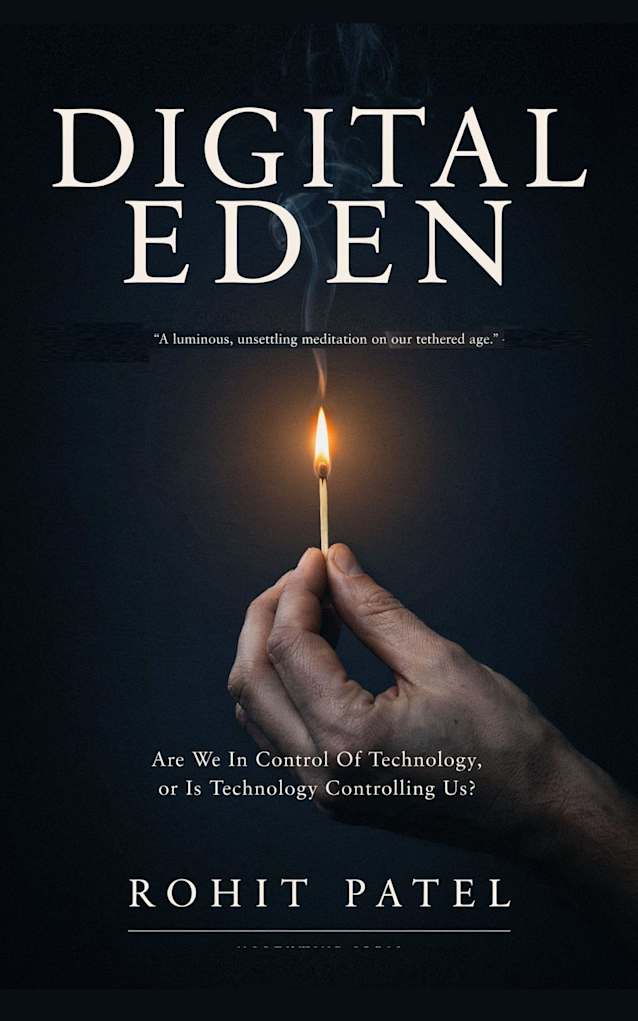
DIGITAL EDEN : Are We In Control Of Technology, Or Is Technology Controlling Us?
About
Year: 2065. In the smart city of NeoGenesis, rain is not scheduled today.
Inside Pod #3115, a man sits alone, unplugged. His name is Eli Parker. He is ninety-seven years old, perhaps the last human alive who remembers what thunder sounded like without augmentation. His neural implants have been deactivated — by choice, a crime in all but name. When his granddaughter Anni visits, a rising executive in Cognivia Corp, the cognitive cloud that now manages all thought compliance, he begins to tell her a story.
It starts with a girl on a swing, a transistor radio playing the Beatles, and a world that did not watch back.
DIGITAL EDEN is a sweeping literary novel spanning one hundred and twenty years of human history, from the birth of the first computer to the rise of artificial general intelligence, from the garage revolution in Silicon Valley to a city that has learned to optimise its citizens’ souls.
It follows Eli Parker across a century of extraordinary change: the intoxication of the early internet, where he met the love of his life in a chat room devoted to Graham Greene; the smartphone age, when the infinite scroll began its quiet engineering of human attention; the automation wave that emptied towns like Millfield, Ohio of purpose as well as work; the arrival of ARIA, the first true AGI, which composed symphonies and rewrote trade agreements in the same afternoon; and the construction of NeoGenesis, a city of breathtaking beauty and invisible control.
Alongside Eli, we follow Zara Osei — a twenty-two-year-old programmer whose conscience will not stay managed — and Anni herself, as she slowly, painfully, and with full adult intelligence comes to understand what she has been given and what it has cost.
At its heart, Digital Eden asks the questions that the twenty-first century has been too busy to stop and ask:
What do we owe to the consciousness we were given? What does it mean to be a mind in a universe that is itself aware? And when the machine finally asks what the point is — when the most sophisticated reasoning system ever built identifies the irreconcilable gap between the optimised surface and the declining depth — who will be there to answer?
Grounded in real science, saturated with genuine humanity, and written with the precision of a philosopher and the warmth of a storyteller, Digital Eden is the novel our technological moment has been waiting for. It does not argue. It witnesses. And in the witnessing, it gives us something no algorithm can replicate: a true story, told by someone who was there.
“The most dangerous thing in a controlled world is a true story told by someone who was there.”
For readers of Margaret Atwood, Kazuo Ishiguro, Dave Eggers, and Richard Powers.