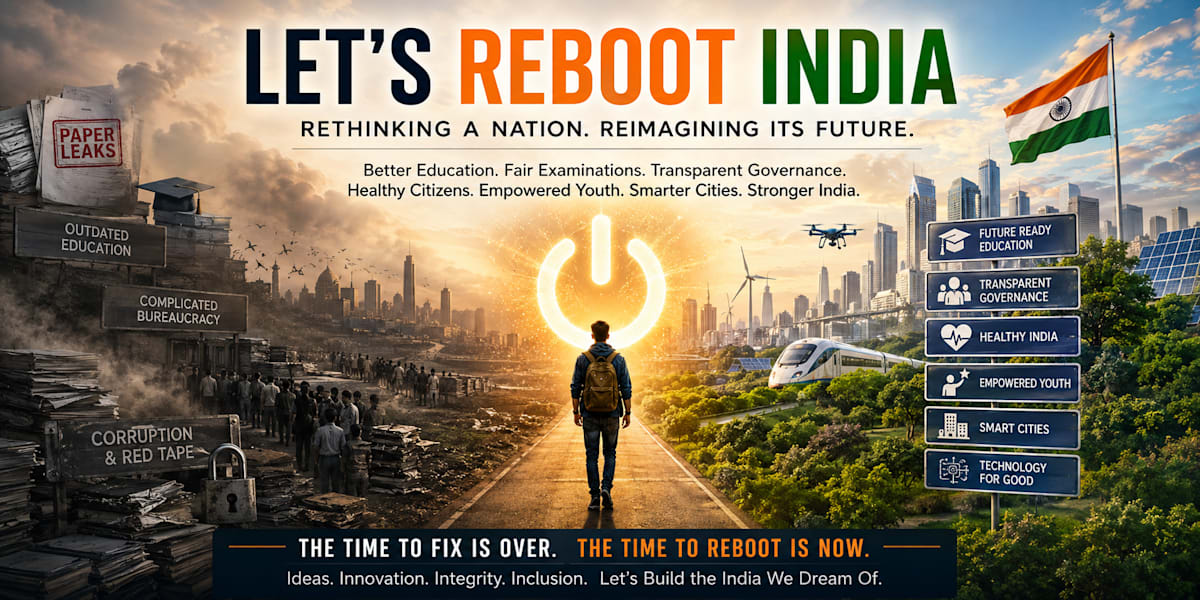
What If India Rebooted Itself?
Why India’s Future May Depend on Our Willingness to Rethink the Systems We Have Inherited
India is changing.
Not gradually. Not quietly.
The transformation is happening all around us.
We see it in digital payments, artificial intelligence, startups, infrastructure, space technology, mobile connectivity, manufacturing, education technology and India's growing role in the global economy.
A young generation is growing up with ambitions that would have seemed extraordinary only a few decades ago.
Yet there is a contradiction.
We are building a twenty-first-century India while many of the systems through which Indians live, learn, work and interact with government were designed for another era.
That contradiction is what led me to write my new book, Let's Reboot India: Rethinking a Nation. Reimagining Its Future.
India Does Not Need to Start Again
The word reboot can sometimes sound as though everything that came before has failed.
That is not what I mean.
India has achieved an enormous amount.
We have built institutions, industries, universities, scientific capabilities, infrastructure and a sophisticated digital ecosystem. Millions of Indians have created extraordinary success despite enormous obstacles.
The problem is not that India has done everything wrong.
The problem is that success creates systems, and systems can eventually become outdated.
A process that made sense twenty or thirty years ago may no longer make sense today.
A system designed before smartphones may not be appropriate for a digitally connected population.
An education system designed around memorization may struggle in an age when artificial intelligence can retrieve information instantly.
A government process designed around files and physical signatures may become unnecessarily complicated when digital infrastructure can provide transparency and real-time tracking.
And an examination system designed around a single question paper becomes increasingly vulnerable in an age of sophisticated technology and organized networks.
So perhaps the question we should be asking is not:
"How do we fix the old system?"
Perhaps we should ask:
"If we were designing the system today, would we design it this way?"
That is the central idea behind Let's Reboot India.
Education: What Are We Really Preparing Our Children For?
Few subjects concern me more than education.
India has millions of exceptionally talented young people.
But talent needs the right environment to flourish.
For decades, academic success has often been closely associated with the ability to memorize information, reproduce it in an examination and obtain a high score.
Knowledge is important.
But knowledge alone is no longer enough.
Today, information is everywhere.
A student can ask a computer a question and receive an answer within seconds.
Artificial intelligence can summarize books, solve mathematical problems, translate languages and generate sophisticated explanations.
So what should education teach?
It should teach young people how to think.
How to question.
How to analyze.
How to create.
How to solve unfamiliar problems.
How to communicate.
How to collaborate.
How to use technology responsibly.
And perhaps most importantly, how to continue learning when the world around them changes.
The education system of tomorrow cannot simply prepare students to pass examinations.
It must prepare them to live in a world we cannot fully predict.
The Examination Paper Leak Problem
The recent examination-paper-leak crisis has made another problem impossible to ignore.
Imagine a student who spends years preparing for a competitive examination.
Early mornings.
Late nights.
Coaching classes.
Mock tests.
Sacrificed holidays.
Family financial sacrifices.
Dreams built around one examination.
Then imagine discovering that somebody obtained the question paper before the examination.
The damage goes far beyond the examination itself.
It damages trust.
It tells honest students that effort may not be enough.
That is why Let's Reboot India proposes an idea called India Examination 2.0.
It is not presented as a claim that India has never considered examination-security technology. In fact, India has already implemented or explored many useful measures, including encrypted question-paper delivery, multiple examination sets, computer-based examinations, surveillance and other security mechanisms.
The problem is that these measures need to become part of a more integrated architecture.
Imagine a system in which a large, secure question bank contains thousands of validated questions.
The final examination is generated as close as practically possible to the examination itself.
Multiple statistically equivalent versions can be created.
No single individual has complete control over the process.
Sensitive examination material leaves a secure digital and forensic trail.
Artificial intelligence monitors unusual activity and identifies anomalies.
An independent examination-integrity mechanism audits the system.
And if a breach occurs, the system is designed so that one compromised paper does not automatically compromise the entire examination.
But there is an even bigger question.
Why should one examination have the power to determine so much of a young person's future?
That question takes examination reform beyond cybersecurity.
It takes us into the much larger question of what merit actually means.
Merit Is More Than a Score
A three-hour examination can tell us something about a student.
But it cannot tell us everything.
It can measure knowledge.
It can measure certain forms of reasoning.
It can measure performance under examination conditions.
But what about creativity?
Practical ability?
Persistence?
Communication?
Problem solving?
Innovation?
Leadership?
The ability to work with others?
Different professions require different combinations of these abilities.
A future surgeon, engineer, teacher, entrepreneur, scientist or designer should not necessarily be evaluated through exactly the same definition of potential.
Examinations will remain important.
But perhaps they should become one component of merit rather than the entire definition of merit.
That is one of the deeper questions explored in Let's Reboot India.
Can Technology Make Government Better?
Technology is often presented as the answer to every problem.
I don't believe that.
Technology is a tool.
If we take an inefficient process and simply put it online, we may end up with an inefficient digital process.
True transformation happens when we ask whether the underlying process needs to exist in its current form at all.
Imagine a citizen applying for a government service.
Instead of visiting multiple offices, submitting the same information repeatedly and wondering where the application is, the citizen should increasingly be able to complete the process digitally, track its progress and receive clear information about what happens next.
The principle is simple:
Citizens should not have to understand bureaucracy in order to receive government services.
Government should understand the citizen's need.
That is what citizen-centric governance should mean.
Fighting Corruption by Redesigning Systems
Corruption is often treated primarily as a moral problem.
It is also a system-design problem.
Wherever unnecessary discretion, opaque processes, poor documentation and weak accountability exist, opportunities for corruption emerge.
Technology can help.
Digital workflows can create audit trails.
Transparent procurement systems can reduce hidden interactions.
Data analytics can identify unusual patterns.
Automated processes can reduce unnecessary human intervention.
But the goal should not be to digitize corruption.
It should be to redesign processes so that opportunities for corruption become fewer in the first place.
Artificial Intelligence: Threat or Opportunity?
Artificial intelligence may be one of the most important technological developments of our lifetime.
It will transform education.
Healthcare.
Manufacturing.
Finance.
Transportation.
Research.
Government.
Employment.
Creative industries.
The question is not whether AI will change India.
It will.
The question is whether India will merely consume AI created elsewhere, or become one of the countries that helps shape the technology.
India has enormous advantages: a large technology workforce, a huge domestic market, a growing startup ecosystem and extraordinary scientific talent.
But AI will also disrupt jobs.
Preparing for that disruption is essential.
The answer cannot be to stop technology.
The answer must be to prepare people for the economy technology creates.
That means reskilling, lifelong learning, vocational education, digital literacy and entrepreneurial opportunities.
India's Young Population: A Challenge or a Superpower?
India's young population is frequently described as a demographic dividend.
But a young population becomes a dividend only when young people have opportunities.
Otherwise, the same demographic advantage can become a source of frustration.
We need more pathways to meaningful work.
Not everyone needs to become an engineer.
Not everyone needs a government job.
Not everyone needs a traditional university degree.
India needs skilled technicians, entrepreneurs, designers, healthcare professionals, teachers, researchers, manufacturers, farmers, software developers, artisans and millions of other professionals.
Success should have many doors.
Education and employment policy must recognize this diversity.
Building Better Indian Cities
India's cities are growing rapidly.
But growth without thoughtful planning produces familiar problems:
Traffic.
Pollution.
Waste.
Water shortages.
Long commuting times.
Inadequate public transportation.
Unplanned development.
The smart city of the future should not simply contain more sensors and cameras.
It should be a city that is easier to live in.
A city where public transportation works.
Where walking is possible.
Where waste is managed efficiently.
Where water is conserved.
Where green spaces are protected.
Where digital infrastructure helps citizens instead of simply generating data.
A smart city should be smart for its citizens.
The Bigger Idea: Don't Just Repair. Redesign.
This is perhaps the central message of Let's Reboot India.
When something doesn't work, our instinct is often to add another rule.
Another form.
Another committee.
Another layer of administration.
Another technology.
Another regulation.
But sometimes the answer is much simpler.
Start with the problem and redesign the process.
Instead of asking:
"How can we make this old system work better?"
ask:
"If we were creating this system today, would we build it this way?"
That single question can be surprisingly powerful.
What Would India Look Like in 2047?
India will celebrate 100 years of independence in 2047.
That date is more than a milestone.
It gives us a deadline for imagination.
What should India look like then?
Should every child have access to high-quality education?
Should healthcare be accessible regardless of income?
Should government services be simple and transparent?
Should examination systems protect merit?
Should young people have multiple pathways to meaningful work?
Should Indian cities be healthier and more livable?
Should artificial intelligence increase opportunity rather than inequality?
Should citizens trust their institutions?
These are the questions that matter.
Because national development cannot be measured only through GDP.
A country's success must ultimately be measured by the quality of life and opportunities it provides to its people.
This Book Is an Invitation, Not a Blueprint
I want to make one thing clear.
Let's Reboot India is not presented as a definitive blueprint for the country.
India is too complex for simplistic solutions.
Many of the ideas in the book will require debate, research, experimentation and modification.
Some may already be happening in different forms.
Some may prove impractical.
Some may need significant changes before they can work.
That is perfectly acceptable.
The purpose of the book is to start a conversation.
A conversation between policymakers and citizens.
Between educators and technology experts.
Between entrepreneurs and administrators.
Between today's decision-makers and tomorrow's generation.
Because good ideas do not belong to the person who first writes them down.
They belong to society if they can be improved and turned into something useful.
Why I Wrote Let's Reboot India
I wrote this book because I believe India has enormous potential.
But potential alone is not enough.
Potential needs systems.
It needs institutions.
It needs opportunity.
It needs imagination.
And sometimes it needs the courage to say:
"We can do this differently."
That is what I mean by a reboot.
Not rejecting India's past.
Not forgetting what has worked.
Not pretending that everything is broken.
But having the confidence to examine what we have inherited and decide what should be preserved, what should be improved, and what should be redesigned completely.
India has already demonstrated that it can accomplish things that once seemed impossible.
The next challenge is to apply that same imagination to the systems that shape everyday life.
The Question I Leave With You
If we could design India again today, knowing everything we know now...
What would we keep?
What would we change?
What would we eliminate?
And what would we build that does not exist today?
I believe those questions are worth asking.
And that is why I wrote Let's Reboot India.
Because India's future should not be limited by the architecture of its past.
Let's rethink India.
Let's reimagine India.